


We landed in Idaho this week for what was supposed to be a quiet week of vacation, but smoke from numerous wildfires has consumed the air. The air quality has soared to over 180 (less than 30 is good) with levels nearly ten times the World Health Organization’s annual guideline. Since this part of the country has had wildfires in the summer for years, we assumed they would have protocols to keep the indoors air at the resort safe - they did not.
This smoke isn’t just wood from a campfire, it’s ash from building materials in homes, bodies of animals, rubber and chemicals from cars that have been burned. My own home was destroyed in a fire as a child, and more people die from smoke inhalation than the fire itself during these tragedies. I kept thinking of the dad from This is Us lingering in his house fire too long…
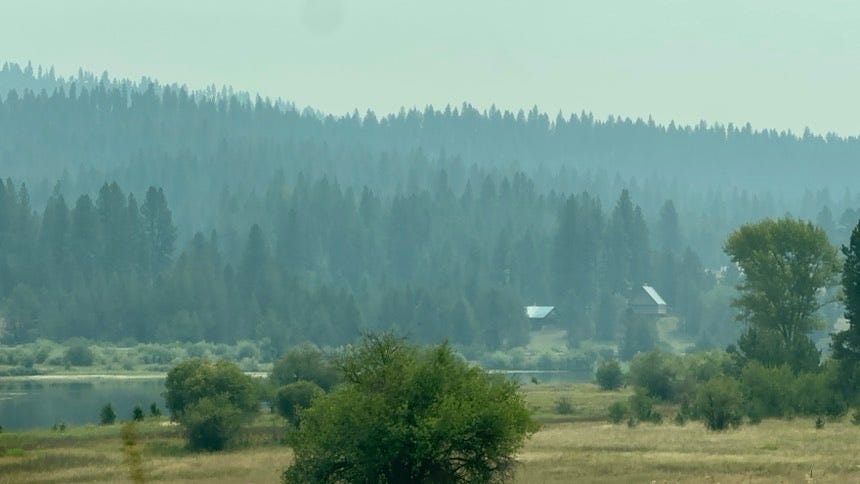
Cascade Mountains, Idaho with the smoky haze.
It’s now common knowledge in wildfire affected areas that you:
keep all exterior windows and doors closed,
run HVAC fans on constant (not “auto”) so filtration is continuous rather than intermittent,
ask those in the buildingto keep entrance doors closed
Basic responsibilities for keeping those safe in your care - or at least giving them an option.
But not at this resort. We went into the restaurant and were asked if we wanted to sit outside or inside, yet once we were seated inside I noticed an exterior door propped open in the restaurant. I was about to close it, when I noticed the entire bar wall wasn’t just propped open. It was gone — folded back entirely, turning what should have been a sealed, climate-controlled indoor space into an open-air extension of the smoky outdoors!
And here’s what has lingered with me longer than the smoke: no one else seemed to care. Guests sat at the open bar, drinks in hand, unbothered. Staff moved through the space as though nothing were unusual. Nobody had propped a sign. They were breathing in the thick toxic air as though this was normal not deadly.
The Bystander Effect, Indoors
There’s a term for this called the bystander effect — the well-documented psychological phenomenon where the more people who witness a problem, the less likely any individual is to act on it. The responsibility to act gets quietly divided among everyone present, and in the dividing, it tends to disappear. Everyone assumes someone else has it handled, or will handle it, or already knows something you don’t.
It was first studied in the aftermath of a 1964 murder in New York City, where dozens of witnesses reportedly failed to intervene or call for help, each apparently assuming someone else would. The research since then has replicated the pattern in far less dramatic settings — a room slowly filling with smoke during a lab experiment, an alarm going off in an office building, a colleague clearly struggling in a meeting. The finding holds up again and again: in a group, the instinct to act gets diluted, not amplified.
Why we don’t speak up: The risk of being labeled a “Karen”
Add to this bystander effect the modern concern that you might be considered a"Karen," - an entitled, demanding, person (usually woman) who is quick to escalate minor grievances by asking to "speak to the manager," calling authorities over trivial concerns, or otherwise using her perceived social status to pressure others into compliance. This new social fear I’m concerned is keeping intelligent people from using their voice.
Are we so worried about what people might think about us when we speak up that we don’t think about how our silence impacts others - or our own health?
I think about the excuses that keep the bystander effect running, because I thought about reaching for every one of them before asking to “speak to the manager:”
We are tired. Vacation is supposed to be the one place we get to stop being vigilant. Raising a concern feels like clocking back in.
If it was that concerning, others would be speaking up. This is the bystander effect’s engine room — we read the calm of the crowd as evidence of safety, when often it’s just evidence that everyone else is reading us the same way.
We trust those in charge to take action. Surely the hotel knows what it’s doing. Surely there’s a protocol. Surely someone with more information than we have has already made the call.
What if there’s retaliation? In a workplace, this one carries real weight — the fear of being labeled difficult, of jeopardizing a relationship, a job, a reservation, a friendship. Even in a hotel bar, some quiet version of “I don’t want to be that guest” was operating on everyone in that room, myself included, for about the first ten minutes.
Every one of those excuses is reasonable in isolation. Together, they’re how a room full of people sits calmly in unhealthy air, because each person has quietly delegated the responsibility to speak up to someone else who is doing exactly the same thing.
I didn’t want to be the person making a scene in a hotel, but I also knew that closing one door wasn’t going to fix an open wall, and that whatever I said out loud in that moment was going to evaporate the second I walked away.
So here are the skills of effective persuasion I’ve learned from high-stakes government advocacy that I applied to this real-world situation:
